
The Program
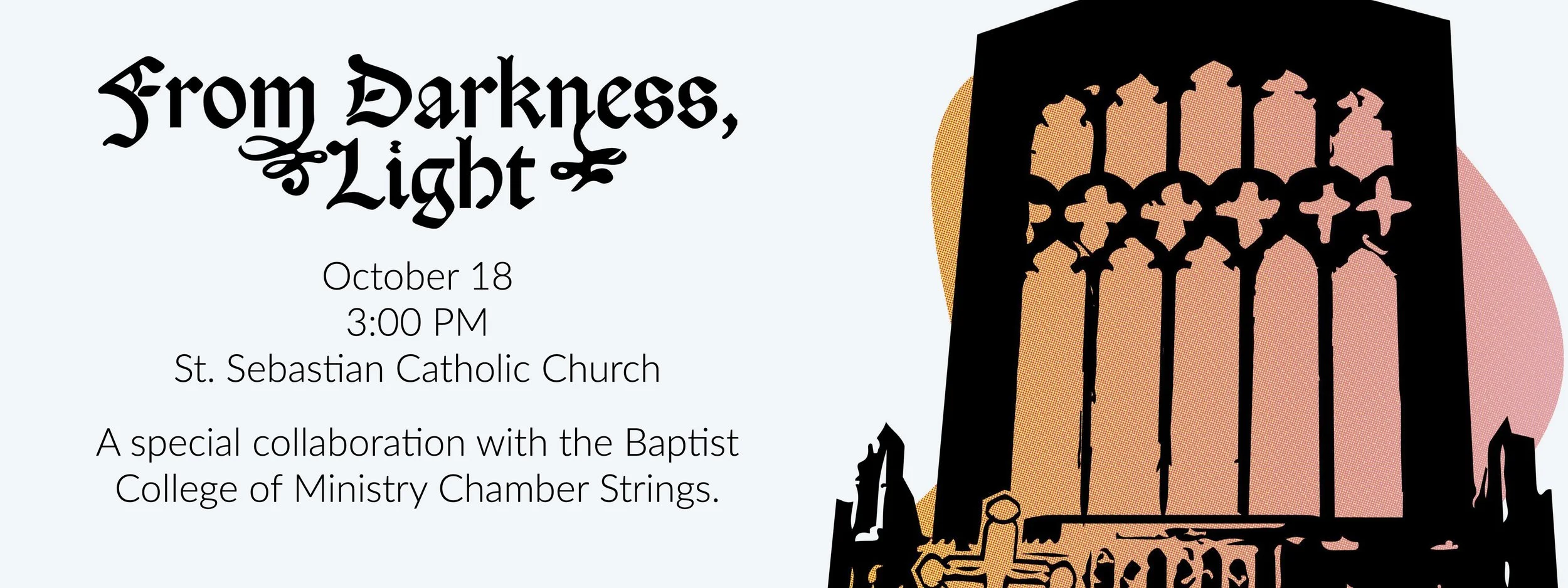
Before audiences came to know it as the “Nelson Mass,” Haydn titled his new 1798 composition Missa in Angustiis, the "Mass for Troubled Times." Written amid political uncertainty and the turmoil of war, this extraordinary masterpiece transforms feelings of anxiety into a powerful expression of hope, faith, and triumph. Bel Canto Chorus opens its season by pairing Haydn's dramatic and exhilarating work with Ola Gjeilo's Luminous Night of the Soul, a contemporary meditation that explores themes of light, spiritual union, and the divine spirit of art through a vibrant, symphonic soundscape. Featuring the Baptist College of Ministry Chamber Strings, this inspiring program bridges centuries of sacred music, illuminating the enduring human search for light, peace, and renewal through voices and strings.
Repertoire
In the Midst of Life | Richard Hynson
Luminous Night of the Soul | Ola Gjeilo
Missa in angustiis “Nelson Mass” | Joseph Haydn
Concert Details
October 18, 2026 | 3:00 PM
St. Sebastian Catholic Church
5400 W. Washington Blvd.
Milwaukee, WI 53208
Run time: approximately 80 minutes (includes an intermission)
Parking
To enter, use Door 14 off of 54th street. (ADA accessible)
Parking is available in the school parking lot to the north of the church office. Street parking is also available in the neighborhood.
Deep Dive
Haydn fun facts:
The “Nelson” nickname came after the fact. Haydn did not write the Mass specifically for Admiral Horatio Nelson. The nickname became attached to the work after Nelson's victory over Napoleon's fleet at the Battle of the Nile in 1798. Nelson later met Haydn in 1800, when he visited the Esterházy estate.
It was written during a real “time of trouble.” Haydn originally called the work Missa in Angustiis, meaning “Mass in Troubled Times.” He composed it in 1798, when Napoleon's forces were threatening Austria. The music's dramatic, urgent character reflects that turbulent setting.
The music takes us from darkness to celebration. The Mass begins in D minor with a tense, almost ominous atmosphere, but by the end, the Dona nobis pacem brings a powerful sense of triumph and hope. That dramatic journey—from anxiety to joy—is one reason the work remains so compelling for audiences today.
Gjeilo fun facts:
It’s a sequel. Luminous Night of the Soul was written in 2011 as a companion—or “sequel”—to Gjeilo’s Dark Night of the Soul, which was written the year before. The two pieces can be performed independently, but Gjeilo also conceived them as connected parts of a larger musical journey.
The words come from two different poets—and two different centuries. Most of the text was newly written for Gjeilo by contemporary poet Charles Anthony Silvestri. Gjeilo then incorporated a stanza from the 16th-century Spanish mystic St. John of the Cross, creating a direct connection to Dark Night of the Soul.
The “night” in the title isn't really about darkness. The work portrays the soul moving beyond darkness toward a joyful union with the divine. Gjeilo describes Luminous Night as an “exuberant coda” to Dark Night—so despite its mysterious title, the piece ultimately points toward light, fulfillment, and celebration.